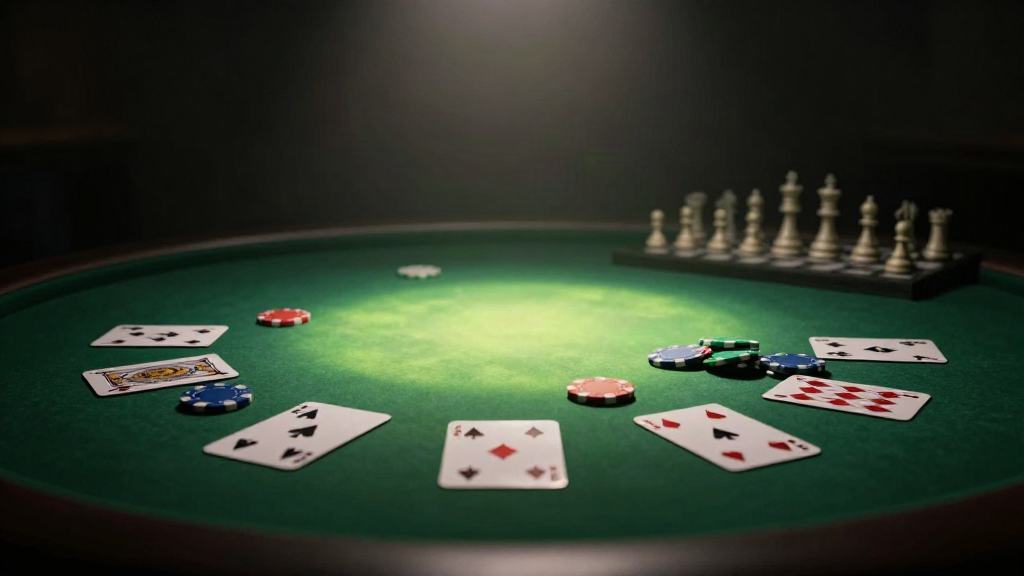
Chess is a promise. Sit down at the board and the world goes quiet, obeying rules. Sixty-four squares, thirty-two pieces, nothing hidden. Every move is arithmetic dressed in wood. You plan three moves ahead, then five, then the whole silent cathedral of the endgame, and if you lose it is because you were out-thought. Chess flatters us. It says the future is knowable, that patience is enough, that a good mind can see the whole board and win.
Life is not chess. Life is poker.
The board you cannot see
In chess, every piece stands in the light. In poker, two cards live face-down in front of you and the rest of the world stays in other people's hands, where you will never read it. You do not get to calculate the future. You get to bet on it.
That is the first lesson, and it arrives like cold water. The hand you are dealt is not fair, and it is not a verdict. It is just the opening position. Some people are born holding aces; others are born with seven-two offsuit. Poker does not pretend otherwise. What it offers instead is stranger and more useful: a way to play a bad hand well, and a way to lose everything holding a good one.
Chess rewards the person who solves the puzzle. Poker rewards the person who can act while the puzzle is still unsolved.
You learn to read people, not positions
A chessboard tells you the truth. A face does not. So poker trains a muscle chess never touches: attention to the small human signals that flicker under the surface. The pause before a call. The too-quick shuffle of chips. The story someone tells with their shoulders when their mouth is saying something else.
You start to notice how people behave when they want something. You start to notice it in meetings, in negotiations, in the quiet moment before someone says yes or no. Poker does not make you cynical. It makes you awake. You learn that everyone is holding cards you cannot see, and that most of the game is asking better questions, not making louder claims.
You learn to hold your own nerves
There is a particular silence in poker, the one right after you commit chips you might never see again. Your heart argues with your head. Your hand wants to move before your mind has finished thinking.
That silence is where nerve is built. Chess rarely asks you to sit still inside uncertainty - it asks you to think harder. Poker asks you to think clearly while your pulse is loud. Do it enough times and the loudness becomes background music. You learn that fear is information, not instruction. You learn to act on a decision you already made instead of on the feeling that arrived one second later.
That skill travels. It shows up the day you send the pitch, quit the job, say the honest thing. Most of life's hard moments are just a river card you have to watch land without flinching.
You learn that risk is a language, not a sin
Chess teaches caution. Every careless move is punished, forever, on a board that remembers. Poker teaches something harder and more true: that folding every hand is not safe, it is simply a slower way to lose. You cannot win a pot you refuse to enter.
So poker makes you fluent in risk. Not reckless - fluent. You learn to size your bets to your belief, to risk more when the odds whisper and less when they shout. You learn that the right play sometimes loses and the wrong play sometimes pays, and that judging a decision by a single outcome is how amateurs go broke.
Life runs on the same ledger. The promotion, the move, the person you ask out, the project nobody believes in - all of them are bets. Poker is the only classroom that lets you lose a thousand hands for free and still walk away smarter.
And sometimes, the risk pays big
Here is the part chess can never give you. In chess, the best move and the winning move are the same thing. In poker, there is a moment - you have felt it - when the river card lands and the whole table tilts. You were behind, you chose to stay, and the world rearranges itself in your favour. The chips slide across the felt. The risk you took, the one that felt like a small cold knot in your chest, comes back multiplied.
That feeling is not just about money. It is the body's proof that uncertainty can be a door and not only a wall. Once you have been rewarded for a brave, calculated call, you stop treating risk as something to survive. You start treating it as something to wield. That is one of the great psychological upgrades available to a human being, and poker hands it to you one hand at a time.
A game that fits in your pocket
The beautiful thing is that this training does not require a casino, a bankroll, or any real stakes at all. The lessons are in the decisions, not the dollars.
PokerTrio is built for exactly that kind of practice. Three-player Sit & Go tables deal fast, so you cycle through more reads, more nerve tests and more risk decisions in an afternoon than a slow six-max cash game gives you in a week. You start with an 8,888 TRIO welcome stack - no deposit, nothing to lose but the hand in front of you - and daily login rewards keep the seat warm. Between tables you can wander into the arcade slots, and if you string together enough good decisions, the top-100 leaderboard hands you the oldest reward in poker: bragging rights.
Small table. Big possibilities. And a place to learn the game that life is actually playing.
TRIO is a speculative prelaunch coin with no guaranteed launch, so treat staking and rewards as part of the fun, not a promise. Play the decisions, not the outcome.
Chess teaches you to see the future clearly. Poker teaches you to move through it when you cannot see it at all. One is a lovely fantasy. The other is Tuesday. Learn to sit inside the chaos, read the room, steady your hands, and bet on yourself when the odds are unclear - and you will find you have been getting better at life the whole time, one hand at a time.