You know the feeling. You open a giant poker lobby, and the screen fills with thousands of names you'll never read, seats you'll never remember, and tables that reshuffle before you finish a hand. You're not a rival there. You're seat 4,712 of 40,000, a number in a queue.
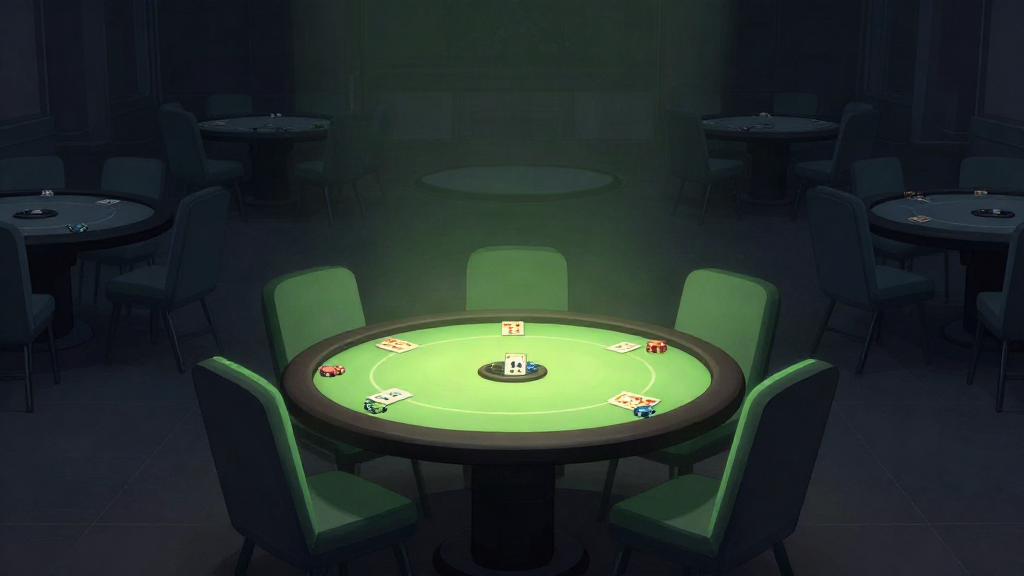
Now picture the opposite. A three-seat table. Two other players. One short Sit & Go. Suddenly every chip matters, every showdown has a story, and the person across from you is someone you actually want to beat again next round.
That's the whole argument in one breath - and it explains why small-table features keep winning over massive, impersonal lobbies.
The math of a massive lobby
Big lobbies are built for volume, not for you. They optimize for how many games run at once, which sounds generous until you feel it from the inside.
Walk into one and you get the same flat experience every time:
- Opponents you'll never play twice.
- Tables that break and reform the second a seat empties.
- Chat that scrolls too fast to say anything real.
- A rank ladder so tall that your progress feels invisible.
When nobody can recognize you, nothing you do carries weight. You can win a hand against a stranger and it evaporates by the next deal. You can lose one and no one notices. That's not competition. That's traffic.
The strange part is that all that scale is supposed to mean "more players to beat." In practice it means fewer opponents who matter.
Why three seats change everything
Shrink the table and the psychology flips. With only two rivals in front of you, the game stops being anonymous and starts being personal.
Three things happen the moment a room gets small.
You become a recognizable rival. Play a few rounds and you start reading the same few styles: the player who always min-bets, the one who over-raises when they're nervous, the one who folds anything short of a monster. Memory does the work that algorithms do in a giant lobby - and it's more fun to guess with your gut than to grind against a rank.
Every action has a witness. When two people are watching, a bluff lands harder and a bad call stings longer. There's a social cost to your moves, and that's exactly what makes them feel like moves instead of button clicks.
Playful competition replaces rank-chasing. At a small table you're not climbing an endless ladder. You're settling a score with the same two names. That's heads-up drama, not homework.
This is the core of what makes free online poker with friends so sticky: it's small enough that personalities survive the shuffle.
Noise versus tells
A massive lobby is loud in the wrong way. Flashing, crowded, endless. There's so much happening that you stop noticing anyone.
A small table is quiet in the right way. You can hear a decision settle. You can see a pattern form over three hands instead of three thousand.
That difference shows up in how the games feel to play:
- In a giant lobby, you chase volume. More hands, more tables, more noise - and less memory of any of it.
- At a small table, you chase reads. Fewer hands, sharper decisions, and a running rivalry you carry between sessions.
One is busy. The other is alive.
Playful beats personal-best
Here's where small tables edge out even the best solo grind. Big rooms sell you a private ladder - your rank, your stats, your climb. It's motivating, but it's lonely. You're competing against a number, not a person.
Small tables put a face on the other side of the felt. Bragging rights get concrete. You don't say "I climbed twelve spots today." You say "I knocked Mira out three times in a row." One is a spreadsheet. The other is a story.
That's the sweet spot for casual players who want quick, low-stakes fun: the stakes stay light, but the rivalries feel real. Small table. Big personality.
How a small-table room actually works
PokerTrio takes this idea and builds the whole room around it rather than bolting a private table onto a giant index.
You sit down at fast three-player Sit & Go tables - no waiting behind a queue of hundreds, no anonymous mass migration every time a seat frees up. Around those tables sit the supporting features that make a tight room feel like a club:
- A free 8,888 TRIO welcome stack, so you can take a seat without a deposit.
- Daily login rewards, which gently pull you back to the same room and the same rivals.
- Arcade-style slot machines for when you want a quick spin between hands.
- Staking and a top-100 leaderboard, so playful competition still has bragging rights.
Notice the design pattern. Everything points inward, toward a small, familiar, repeatable table - not outward, toward a sea of strangers. That's the difference between a lobby you scroll and a room you return to.
Small table, honest table
Small doesn't mean careless, so here's the plain part.
PokerTrio is free to play, and no deposit is required to start - your welcome stack and daily rewards are enough to take a seat. Any winnings you chase are tied to TRIO, which is a speculative prelaunch coin with no guaranteed launch and no guaranteed value. Playing and staking do not guarantee real, withdrawable winnings. Treat the fun as the point, and treat TRIO with clear eyes.
Small tables make the game feel more human. Clear rules keep it honest.
The takeaway
Massive lobbies give you more players and less of everything that makes poker fun. Small tables flip that trade: fewer opponents, more meaning, and a rivalry you actually remember.
So skip the crowd. Take a seat where the other two players know your name - or at least know your bluff. Small table. Real rivals. That's the game worth coming back to.